#TWIGE - 06 - TaylorMade Hi-Toe 5 goes forged
The first forged Hi-Toe added five sole grinds and full-face grooves. Its value depends on where you strike open-face shots and which shots you actually play.
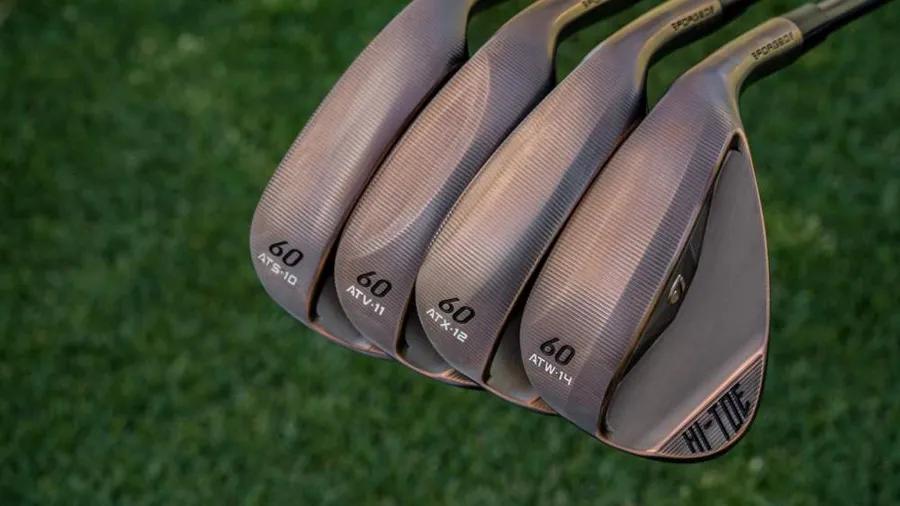
Photo: TaylorMade Golf.
TaylorMade’s Hi-Toe 5 announcement on 13 August presented a wedge with more face than most golfers are trying to use. The toe is taller, the grooves run from heel to toe, and five sole grinds sit beneath it. For the first time in the Hi-Toe line, the head is also fully forged from carbon steel.
Those are clear changes. They still leave a more useful question unanswered: do your short-game shots make use of them?
Hi-Toe 5 opened for pre-order on 13 August, with worldwide retail availability stated for 3 September. For now, this is an announcement and early-testing story. Golfers will have to wait until September to try the retail clubs.
The strike moves when the face opens
A high-toe wedge makes its strongest case when the golfer opens the face. Rotating the face changes how the sole is presented and can move the impact pattern towards the toe. Grooves that continue into that area give the ball a scored surface when contact occurs away from the conventional centre portion.
TaylorMade says Hi-Toe 5 uses the same saw-milled groove geometry as its MG5 wedge and adds laser-etched Spin Tread channels intended to move moisture away from the contact point. Its 13 August announcement attributes more spin and control to the groove construction and raw face. Those are manufacturer claims. The announcement does not establish how large the benefit is for a particular player, strike or condition.
Forging needs similar restraint. It changes the construction and TaylorMade positions it as a route to better feel and feedback. Feel is valuable, but it remains a golfer response rather than a guarantee that the ball will finish closer to the hole. The face shape, strike and sole can affect a shot more directly than the word “forged” on the product story.
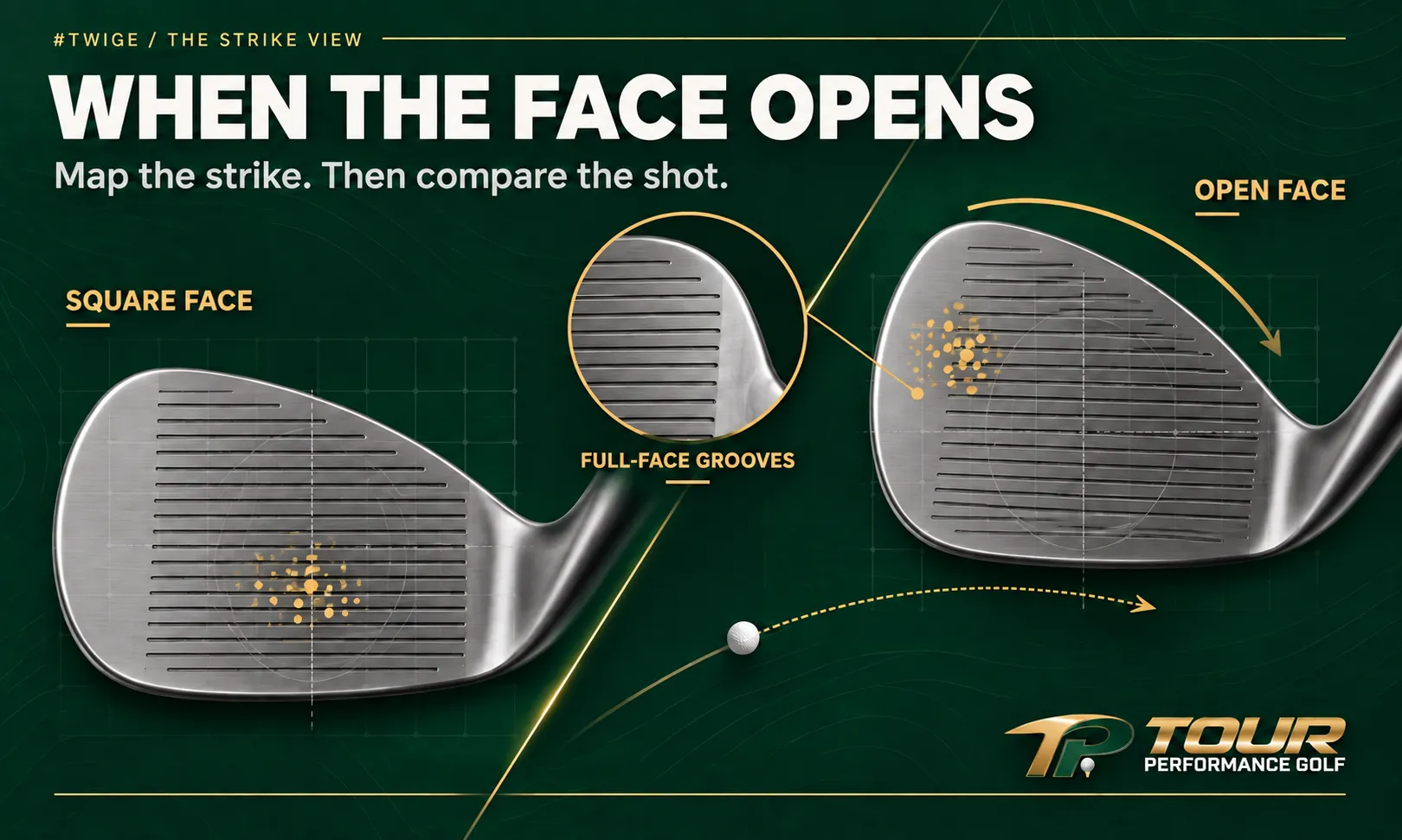
Illustrated contact areas on generic wedge heads show why groove coverage matters.
Early testing supports a trial, not a verdict
Golf Monthly’s Sam De’Ath tested a 54-degree Hi-Toe 5 in its performance lab and on the course. He reported more than 7,600 rpm on targeted 50-yard pitches, a 26.9-degree launch and a 27-foot peak height. He also found the full-face grooves useful on the toe-side strikes produced by his open-face bunker and finesse technique.
Those numbers describe one tester, one loft and the publication’s setup. The article does not report a sample size or a same-session comparison with Hi-Toe 4, so it cannot quantify the improvement delivered by the new generation. It does show that the test club produced a controlled flight and high spin for that player.
A second launch-day review from Golfalot also liked the spin and bunker performance, while identifying three reasons to slow down: the larger footprint will not suit every eye, the change from Hi-Toe 4 is not substantial in every respect, and the £179 recommended price is firmly premium. That is useful scrutiny for somebody who already owns the previous model.
Choose the shots before the grind
TaylorMade’s five grinds are not five levels of better. ATS spans 50 to 60 degrees as the broad option. ATV, ATX and ATW cover different sole geometries in higher lofts; the low-bounce ATC is a right-handed custom option in 58 and 60 degrees. Exact availability varies by loft and hand.
Start the comparison with the shots you use. If a 50- or 52-degree wedge is mainly a square-faced full-swing club, a more conventional shape may present a cleaner test. If the highest-lofted wedge is regularly opened from sand, rough or a short-sided lie, the taller toe and full-face grooves have a clearer job.
Use face-marking spray for a separate strike-location check during a fitting, then clean the face before comparing launch, carry, spin and stopping pattern. Hit the square pitch, the bunker shot and the open-face shot you would attempt on the course. The aim is not to celebrate a toe strike; it is to learn whether the design makes your normal variation more playable.
Do the test from the ground you actually encounter. A sole that feels confident in soft sand may present too much bounce from a firm, bare lie. A narrow low-bounce option may look wonderfully neat until a steeper delivery asks it to resist digging. The grind has to work when the face is square and when it is manipulated.
Hi-Toe 5 offers a coherent tool for golfers who use the upper part of a large face and want more sole choices beneath it. For somebody who plays mostly square-faced shots from the middle of the blade, its most visible features may solve a problem they do not have.
The whole face is available. Your strike pattern should decide how much of it is useful.
TWIGE — This Week in Golf Equipment. #TWIGE